What I Learned Building an App at 73 — and Why It Changed How I Think About Our Stuff
Coffee & Code LLC ·I'm 73. In October 2025, I didn't know Swift. This is the app I built anyway — and what I learned along the way about building, AI, and the stuff we own.
This wasn’t part of some grand plan. I just wanted something new to work on, something to keep my mind engaged. What I didn’t expect was that it would turn into an actual app.
It took much longer than I expected, with more than a few “Damn, I think I need to start over” moments along the way. But it became something I’m genuinely excited to share.
It started with a manual
The idea for the app, which I eventually named Stuffolio, didn’t come from a brilliant insight. It came from standing in front of something that wasn’t working and thinking, I know I’ve seen the manual for this … somewhere.
That moment kept repeating itself. I was always looking for the same things: manuals, serial numbers, setup instructions, repair videos, or trying to remember whether a warranty was still valid or had quietly expired. Sometimes the information was in a folder. Sometimes it was buried in an email. And more often than I’d like to admit, it was in “that drawer.”
You know the one.
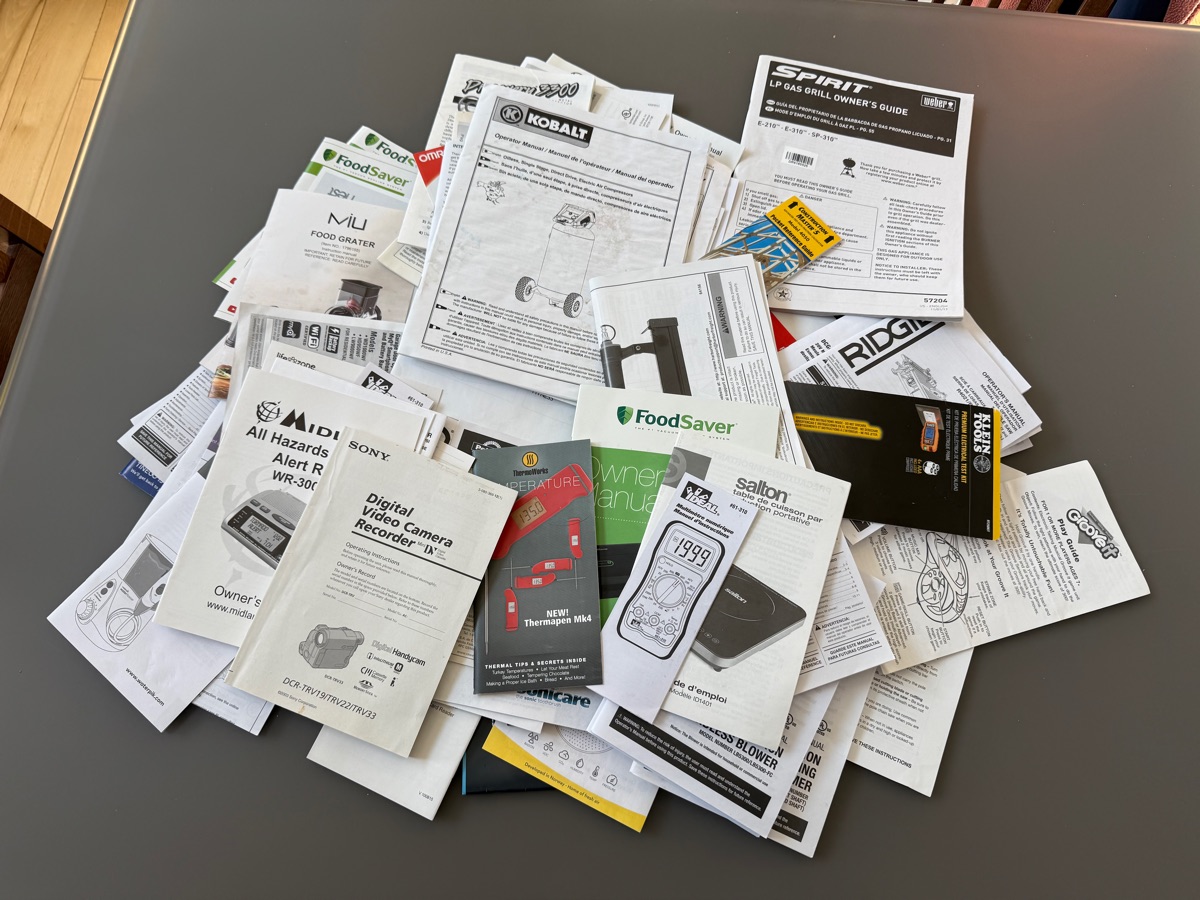
Eventually, I had to admit that “that drawer” was not a filing system.
So I built something simple: a place to keep track of what we own, along with the information we actually need — warranty dates, manuals, support contacts, even online help videos. One place instead of twelve.
But as I worked on it, the questions got bigger.
The questions that changed the app
My wife and I started looking around our home and asking ourselves: Where did all of this stuff come from? And maybe more importantly, what are we eventually going to do with it?
Things have a way of accumulating quietly. Some we bought. Some were gifts. Others just seemed to appear over the years. Along the way, we assumed certain items would naturally become heirlooms — things we’d pass down to our daughters because they mattered to us.
What we’ve learned, sometimes gently and sometimes not, is that what feels meaningful to one generation doesn’t always feel that way to the next. Some of the things we thought our kids would treasure turned out to be things they simply don’t want.
That led to a different kind of question. How do you even talk with your kids about that? Not as a legal conversation, and not as something heavy or uncomfortable, but as a practical way to make things easier for them later?
So we tried it.
One evening, we FaceTimed our two daughters and walked through some of the things we’d always assumed they’d want. The oak school desk we’d picked up at a yard sale. A set of china that had been in the family for decades. Pieces we’d collected while traveling.
They were honest with us. The desk wouldn’t fit either of their lives. The china wasn’t their style. But a few things surprised them — items we’d almost overlooked meant more to them than we expected. And some things we thought were just ours: one daughter asked if she could have them someday, while the other had no interest at all.
It was clarifying for everyone.
It wasn’t a difficult conversation. It was a relief.
What I noticed afterward was that none of us had been avoiding the topic, exactly. We just hadn’t had a reason to start it. Once we did, it turned out our daughters had been quietly forming their own opinions for years, the same way we had — and they were waiting for someone to ask. We agreed to do it again, with different items, whenever it felt natural.
That conversation changed what I was building. I added something I eventually called Legacy Wishes: a simple way to leave context behind. We could describe an item, note why it mattered, and indicate which of our daughters might want it. Just as important, it gave them a way to tell us if they didn’t. If neither wanted something, we could note whether to donate it, sell it, or let it go.
Learning something new later in life
Building the app became its own education.
That wasn’t entirely new for me. In the mid-1990s, while working in the Department of Child and Family Studies at the University of South Florida, I developed ResourceNet and other early online tools in the first years of the web. After leaving the university in 1998, I spent the next twenty-two years working for the Colorado State Courts in a completely non-technical role. I assumed that chapter of my life was behind me.
Retirement turned out to be the thing that reopened it. For the first time in decades I had the time to take on something genuinely hard, and I went looking for it. I wanted the challenge; AI is what made it achievable.
But Swift and modern app development were a different world, so I started the way a lot of people do now: watching instructional videos and trying things out, often without fully understanding what I was looking at. I spent a lot of time staring at development screens thinking, Well, that didn’t work.
Along the way, I discovered that modern AI tools could be surprisingly helpful. I tried several and eventually settled on Claude Code, which could read my project files directly and make changes in place. At first, it felt like they were doing too much of the work, and that made me uneasy and feel a bit like an impostor. But over time, something shifted. They stopped feeling like a replacement and started feeling like hired trades — and I was the general contractor.
I've wired outlets, sweated pipe, laid wood floors, replaced sinks and toilets, and built steps for a terrace, all DIY. I'm not bad. But a professional would do every one of those jobs better and faster, with applied knowledge I'll never accumulate. That's the shape of the relationship: the electrician knows more about wiring than I ever will, but I know the house better than he does. The tools could do the work; I was still deciding what got built, and why.
As I got more comfortable, I noticed something else. I wasn’t just asking questions anymore. I was pushing back, debating answers, and occasionally correcting the tools themselves. Sometimes I was clearly the student. Other times, somehow, I was the teacher.
That back-and-forth is where the learning really stuck.
I was the general contractor
There’s a phrase people use dismissively these days: “AI slop.” It refers to apps and content generated by AI with no human thought behind them — things that work on the surface but fall apart the moment you look closely. Ship it and move on. I understand the criticism. I’ve seen those apps.
But that label gets applied too broadly. It assumes that if AI was involved, the human wasn’t. And that hasn’t been my experience at all.
Yes, AI wrote most of Stuffolio’s code. I’ll say that plainly. I didn’t know Swift when I started — I couldn’t have written this app by hand. But what I did was something the AI couldn’t do on its own. I decided what the app should be, who it was for, and what mattered.
When the AI landed on using green and red for status indicators, I pushed back. I am red-green colorblind. To me, those two “obvious” colors look nearly the same — and no AI was going to catch that, because it doesn’t see the world through my eyes. That’s the whole point: the app got better because of who I am, not in spite of it. I wanted it to work for everyone, so I set clear accessibility standards. Colors could never carry meaning on their own. Important information had to be readable without guessing. And the app had to work properly with VoiceOver for people who rely on it.
Other times, the AI produced code that was technically correct but quietly wrong. Once, it generated a swipe-to-delete gesture for maintenance records — efficient, until I deleted one by accident and realized a confirmation step wasn’t optional after all. Small lessons like that accumulated.
Over months, those decisions became an 800-line document of standards: a colorblind-safe palette, accessibility rules, naming conventions, and patterns for styling and error handling. The AI didn’t write that document. I did, because I learned through trial and error that without it, the codebase would drift into inconsistency every time I added a feature.
That document is the artifact that separates development from “slop.” It’s the opinions I formed by arguing with what the AI produced — questioning it, rejecting parts of it, learning from the parts that worked.
The AI was the hired expertise. I was the general contractor. The house is mine.
The moment it felt real
One afternoon, at Treasures, a thrift store run by a local charity to fund its assistance programs, we came across a cast iron Dutch oven — a Griswold from the 1930s, the kind collectors look for. I took a couple of quick photos, ran them through Stuffolio’s Stuff Scout feature, and learned just enough about what it was and what it was worth to make a simple decision.
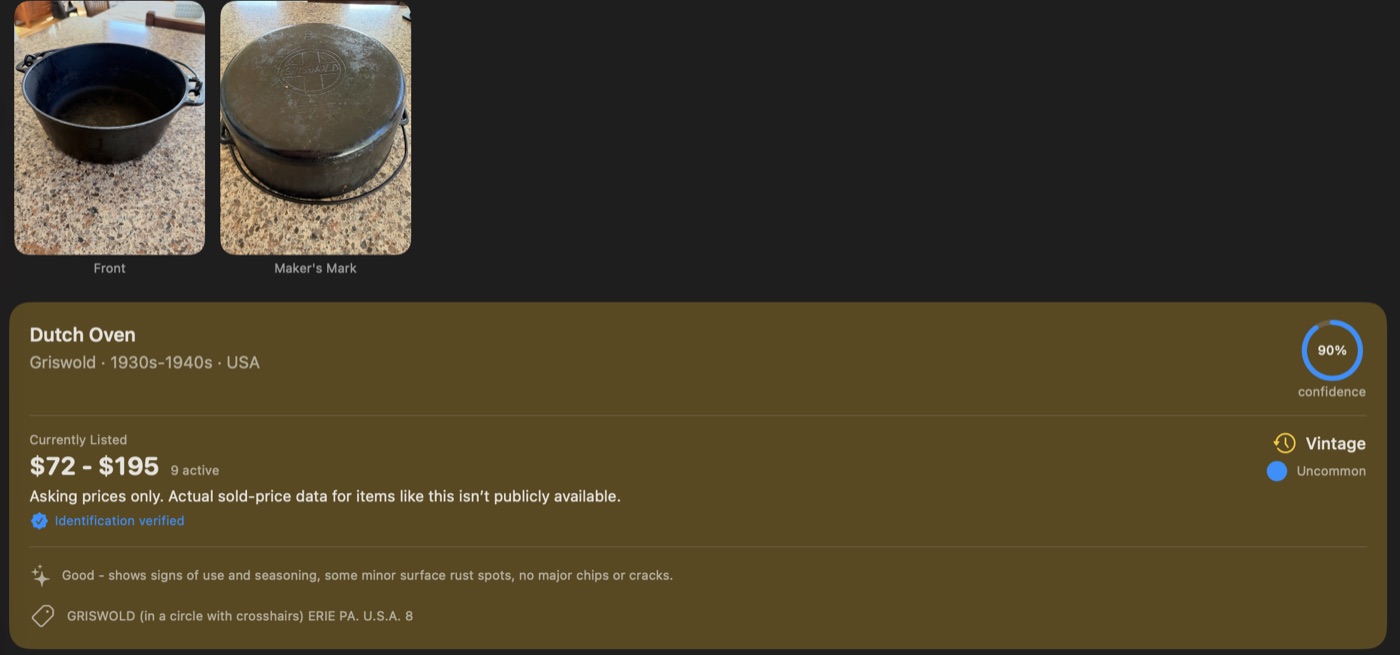
It was tempting. But we already have the cast iron we need, and bringing home another pan would have been exactly the kind of quiet accumulating I built the app to help us notice.
We passed on it. Turns out one of the most useful things the app does is help us not buy things.
That was the whole point. I wasn’t looking for a perfect answer. I just wanted enough information to decide and move on — the same kind of clarity I wanted to leave for our daughters.
What I’m still figuring out
Somewhere along the way, the technical questions gave way to more personal ones. Would someone know what this is? Would they understand why it mattered, or feel comfortable letting it go? Would the people I care about most be left guessing — or have enough context to decide for themselves?
I realized we don’t need more complexity. We need clarity, on our own terms.
That’s what I tried to build. And honestly, that’s what I’m still figuring out — like everyone else at this stage of life, trying to make a little more sense of the things we own and what they mean … if anything at all.
What mattered most was that the learning was still mine. Slowly, things that once felt completely opaque started to make sense.
It reminded me that learning later in life isn’t about speed. It’s about being willing to feel uncomfortable long enough for things to click.
Terry Nyberg, 73, lives in Colorado with his wife, two daughters’ worth of forthcoming inheritance decisions, and a junk drawer he’s stopped calling a filing system.
---
Every feature in Stuffolio started the same way: standing in front of something and not having the answer.
The warranty I couldn't find became a tracking system that tells me when coverage is about to expire and what's still actually covered when something breaks. The vacuum that broke six months after we bought it became a feature called Repair, Keep, or Replace, which pulls in repair costs, replacement prices, and the item's age to help make that decision without guessing. The dishwasher manual I swore was in the filing cabinet became a product memory that stores manuals, receipts, setup notes, and support contacts in one place.
And the conversation with our daughters, the one I almost didn't have, became Legacy Wishes.